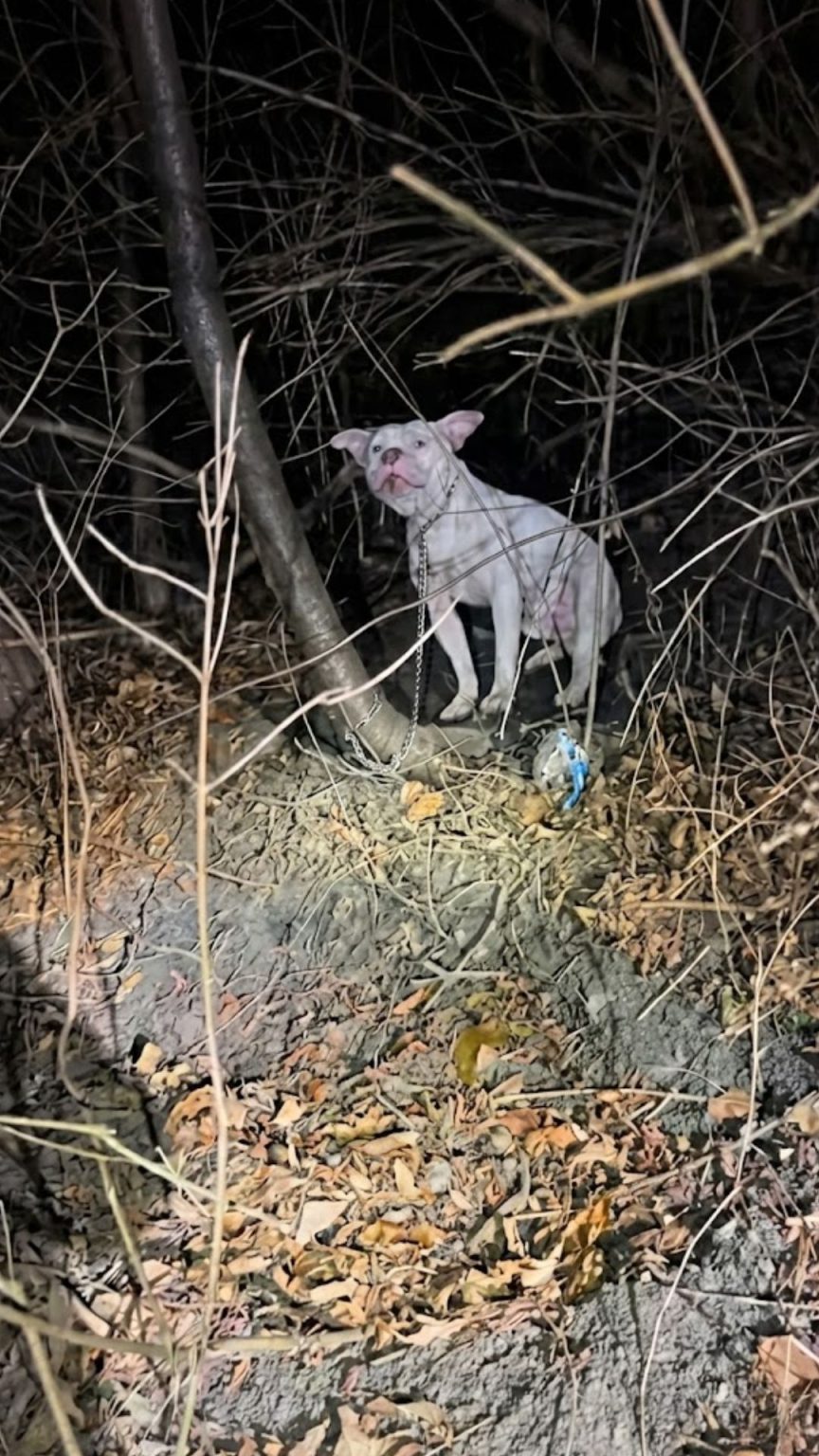
Deep in the woods near Amsterdam, New York, a white pit bull mix stood alone among bare branches and fallen leaves. A metal chain attached to a tree kept him from leaving, while the bitter winter air offered little protection from the approaching night.
The dog had no shelter and nowhere warm to lie down. With only a short length of chain allowing him to move, he remained close to the tree, crouching against the cold and barking into the surrounding woods.
Those barks eventually reached someone walking along a nearby bicycle path with his own dog. The man stopped to listen, then followed the sound into the trees. What he found was a frightened animal whose circumstances made it clear that help could not come soon enough.
VIDEO: Chained to a Tree in the Freezing Woods, a Frightened Dog Is Finally Discovered
The Barking That Led a Stranger Away From the Trail
The wooded bicycle path was quiet when a local resident heard barking somewhere beyond the trail.
At first, the animal was not visible. The sound came from deeper among the trees, away from the area where people normally walked.
Rather than continuing along the path, the man went to investigate.
Following the barking brought him to a white pit bull mix restrained beside a tree. The dog was unable to leave because a metal chain held him in place.
The setting made his situation particularly concerning. Winter temperatures were already dangerously low, and the surrounding woods offered little shelter from the weather.
There was no person nearby attending to him.
The dog’s repeated barking had drawn attention to his location, but there was no way to know how long he had been there before someone heard him.
What mattered immediately was getting him out of the cold.
The resident contacted the Amsterdam Police Department, bringing officers to the wooded area where the dog remained chained.
Their arrival meant that the animal had finally been found, although removing him from the tree would require a careful approach.
A Frightened Dog Made the Officers’ Task More Difficult
When the responding officers approached, the dog did not immediately welcome their attention.
He growled defensively and crouched low, apparently frightened by the unfamiliar people moving toward him.
His response was understandable in the circumstances. He was confined to a small area, exposed to freezing temperatures, and unable to retreat from anything that alarmed him.
The officers needed to free him without making the encounter more distressing.
They approached cautiously, speaking in reassuring tones and allowing the dog time to respond to their presence.
The chain presented another obstacle.
It was secured around the tree and restricted his movements so severely that simply leading him away was not possible.
The officers eventually used heavy-duty bolt cutters to break the metal links.
Once the chain was severed, the dog could finally be moved away from the place where he had been left.
It was a practical intervention, but an important moment in the animal’s ordeal. Until then, his movements had been controlled entirely by the short chain attached to the tree.
Now, the officers could take him somewhere protected from the cold.
“For a frightened dog unable to escape the freezing woods, the sound of that chain being cut marked the beginning of a very different experience with people.”
Inside the Shelter, the Immediate Concern Was His Health
After being freed, the pit bull mix was transported to a local SPCA facility.
The change in surroundings was considerable.
Instead of remaining outdoors among bare trees and frozen ground, he was brought into a warm indoor environment where staff could examine him and address his immediate needs.
His exposure to the cold was an important concern.
Veterinary personnel worked to warm him safely and assess his physical condition after the time he had spent restrained outdoors.
The shelter also needed to consider his fearful behavior.
When the officers first approached him, he had growled and withdrawn into a defensive posture. Such reactions can make handling difficult, particularly when an animal has recently experienced a frightening situation.
At the SPCA, staff could give him a more predictable environment and the opportunity to become familiar with the people caring for him.
There was no detailed medical prognosis provided in the original account, and the extent of any lasting physical effects from his exposure was not established.
What was clear was that he was no longer tied to a tree in dangerous weather.
For an animal who had been unable to find shelter or move freely, that change was significant.
His Abandonment Prompted a Wider Search for Answers
While the dog began receiving care, attention also turned to how he had ended up chained in the woods.
The circumstances raised serious concerns about animal cruelty.
Someone had left a restrained dog in an isolated wooded area during dangerously cold weather, where he could not seek shelter on his own.
The New York State Humane Society responded by offering a $1,000 reward for information that could lead to the felony arrest of the person responsible.
The Amsterdam Police Department also urged residents to report animals found tied outdoors in hazardous conditions.
These efforts reflected the seriousness of the incident and the risk the dog had faced before being discovered.
The original account did not establish who had abandoned him or explain the circumstances that led to his being left at the tree.
There was also no confirmed outcome of the investigation.
Still, the case demonstrated how an ordinary walk had unexpectedly become an important rescue.
The man who heard the barking could have continued along the bicycle path without ever seeing the dog hidden among the trees.
Instead, he investigated the sound and contacted the authorities.
That decision brought the animal’s situation to the attention of people equipped to help.
Slowly, the Dog Began Responding to a Different Kind of Attention
At the shelter, the pit bull mix’s behavior reportedly began to change.
The defensive growling that had marked his first encounters with the officers gradually gave way to more relaxed responses.
Staff observed cautious tail wagging as he became more accustomed to their presence.
It was a small but meaningful development.
The dog who had initially crouched in fear was beginning to respond to people without the same degree of alarm.
These changes did not reveal what he had experienced before being abandoned. His history remained unknown, and it would be impossible to determine precisely what had shaped his earlier reactions.
But they offered encouraging signs that he was becoming more comfortable in his new surroundings.
For the shelter staff, his progress was something they could observe through everyday interactions rather than dramatic milestones.
He had moved from an isolated stretch of woodland into a setting where people could provide food, warmth, attention, and protection.
His long-term adoption outcome was not reported in the original account, but his immediate circumstances had improved considerably.
The white dog was no longer alone in the freezing woods.
His story began with barking that carried through the trees, reaching a stranger who chose to investigate. It continued with officers carefully approaching a frightened animal, cutting the chain that held him, and bringing him to safety.
There is no way to know what would have happened if those barks had gone unheard.
What can be seen is the difference one person’s attention made to an animal who had no means of freeing himself.
“Sometimes, the most important moment in an animal’s life begins when someone hears a sound in the distance and decides it is worth finding out where it came from.”
